Showing posts with label math. Show all posts

Monday, May 17, 2010

Good luck 3rd and 4th graders!

Tomorrow and Wednesday, 3rd and 4th graders will be taking the math MCAS at many schools. Good luck!

This is what I gave my students as a good luck + encouragement:


Good luck on your MCAS,

Final tips:
1) TAKE YOUR TIME!!

2) Read instructions and problems carefully. Read one sentence at a time. Reread if you need to.

3) Cross off answers that you’re sure are not right.

4) Show ALL work, you can get partial credit!

5) Answer the question in full sentences.

6) Check over your work if you have time.


Believe in yourself and you’ll do fine!
YOU GOT THIS!


.

Wednesday, May 5, 2010

When I grow up...

I want to be older.

It's been a few days since MAM ended, so now we're back to regular tutoring entries with a few extra MAM bonus days thrown in.

For Math Rules! volunteers who are reading my blog, the following are my takeaway points:
  • Check in with them and ask how things have been going before you start tutoring. It's a good gauge of how the session will go.
  • Encourage your students in the following couple of weeks before MCAS, let them know they can do well no matter what happened in previous years.
  • Remind them to take their time to read the questions carefully, check their answers, and answer in complete questions for word problems.
  • If you can, take an extra five minutes at the end of your session to chat with them about college and careers. Talk about your college and/or career. For the most part, students are very interested in college but may or may not have someone to ask. Even if they're 3rd graders, if you get them thinking about the future it will help them in the years to come.
  • Help them realize that you're there for them and want them to succeed in everything, not just math!


Yesterday I worked with my fourth graders. They're preparing for the MCAS in two weeks so I helped two students who needed a bit more practice. It's sad because it seemed like my other two students wanted to work with me too. In the end, I think it was better that I was only working with two because I could focus and give them more attention. Also, my teacher has changed her schedule - to prep for MCAS the students are doing 1.5 - 2 hours of math until the MCAS.

MCAS prep means working off of last year's test and trying to figure out best approaches to problems. We went over the standard algorithm for multiplication and division (long division) computations. We also talked about alternative approaches to multiplication problems such as using the array to help with multipication problems. Finally we focused on word problems, which was a good exercise for them to take their time and carefully read all the instructions.


I tried my best to give them test taking strategies like checking answers, rereading the word problems, not falling for the time-wasting tricks, showing all work on the test, and making sure they knew their multiplication and division algorithms.

I found out that both of my students didn't get very good MCAS scores last year and I think it's because they rushed through and didn't check their answers. When we went through the packet, they seemed dejected when I told them their final answers were wrong. It's interesting because most of the work is right, but the final answer is wrong and then they assume they failed.

One of my students kept repeating that she hadn't gotten anything higher than 2s on practice tests throughout the school year. I tried to encourage her by telling her "that was last year, this year you can do better!" I'll see how her self-confidence levels are next week.


We also got a good chance to chat in between problems. I found out that one of my students wants to be a teacher or singer when she grows up. My other student didn't know, and when they asked me, I said I don't know either. :) She retaliated and said "What do you mean you don't know?" That's one of life's secrets, adults sometimes don't actually know what they want to be when they grow up, it's a self-discovery process. We also discussed college briefly which was a good thing, they brought it up and asked me if I was still in college and if it's hard. I told them that it is tough, but if you work hard, you'll end up learning so so much.


We also got off topic and one of my students asked to interview me for a job, which is ironic because I'm in the process of interviewing right now. I also got a chance to interview her and found out some things I didn't know before. She took on a different persona and told me she was a 21 year old singer living in Florida who was interviewing for a teaching position. It was a great chance to bond and talk about jobs and our personal lives. I told her about my new pet hedgehog (shameless plug) and I found out that we both have four siblings.

In a program meeting, we started talking about how to improve Math Rules! for next year and I'll definitely take into consideration how many students are working in a group and the length of math time. These longer math sessions mean more time with the students, more personal attention, and it gives me some space to chat between math problems.


.

Tuesday, April 27, 2010

MAM Bonus: Interview with my sister

I called my sister yesterday to talk about how much math she uses in her school work. She's a second year architecture student at the University of New Mexico. I originally wanted to use it in a blog post, but we started talking about other math related things and I just thought it was interesting enough to get its own blog post. Now, my sister is about 7 times smarter than I am so I hope you'll bear with me through our somewhat philosophical discussion of math.

So I started off asking how much math she uses every day to design. Turns out, because UNM is more focused on the aesthetics of design, they don't rely on math as much as I had hoped. The prerequisite for getting into the architecture program is Trigonometry, and a required Calculus 1 by the time architecture students graduate from the program. Not too much math, if you ask me. Which is a shame because I know my sister is a math rockstar.


She didn't build this one, but similar models.

So I asked her if she uses math in some or all of her projects, I would assume so because designing on paper or the computer and translating it into 3D models requires some sort of math. She told me one of her first projects involved calculating the angles of the sun in conjunction with building a model. She used her trig skills on this project, and many other projects as well.

Most of her models rely on a scale, one inch on the model represents 8 feet or 10 feet in real construction terms. She also pointed out that they calculate slopes from time to time when they're putting in handicap accessible ramps and making sure it's not too steep a slope.

It would seem that she doesn't use hard math as much as I thought architecture students would, but perhaps it's because of her program, or the fact that she's only a student and not a certified and experienced architect (though I hope she gets there soon!).

So I asked her if she uses math every day. She countered with "can we really live a day without math?" After 27 days of everyday math, I would have to say we really can't. If we are living in civilized society, there is no escaping math. Time and money are the two biggest resources people deal with every day, and both are math and number related.


Yesterday I noticed that the bus system relies on numbers and routes, if you mess up your numbers, you'll end up somewhere you didn't want to (this happened to me one day when I hopped on the 23 bus instead of the 22). It happens! And if you're not paying attention to your numbers, you could be stuck somewhere. A bus rider asked me what time it was. People who pay fares need to know how much is enough and how much is too much for a bus fare. Three examples of math while waiting for the bus. You can't get away from it.


Which bus is this? The 23 or the 22?

My sister and I concluded that math has permeated the organization of society so much that it's nearly impossible to not be dealing with math on a daily basis. Most of the time it's unconscious, we don't think about it too hard. After learning how to tell time, we can easily let other people know what time it is, after learning how money works, we can buy and sell things we need, etc. Earlier civilizations relied on barter and trading before money was invented, but there was still some sort of value and wealth system, a cow is worth more than a chicken, and the guy who has 100 cows is the "richest."

But what about societies and cultures that don't rely on time or money? My sister came up with the basic instincts of survival. If humans are living with others, we need to count and estimate in order to survive. To effectively pool our resources and make sure everyone we're interacting with has enough to eat and drink we have to measure and divide accordingly. Humans living outside our definitions of "civilized" society are still dealing with math in one way or another. And if you're stranded on an island, without anyone to share food and shelter with, I would be willing to bet that you're counting the days until you get saved or perish.

Finally, we then discussed if animals have some sort of understanding of math over survival. At first I'm wasn't sure that animals are aware of groups, sharing resources, and possess number sense. However, after doing some internet research, there is evidence that some species do understand concepts of more and less, and can compute simple math problems. An optimizing Corgi, an example of animal calculus.Monkeys can also perform simple addition.


Hans the math horse

I guess it goes to show that even if animals aren't solving complex mathematical enigmas or doing multivariable calculus that some animals posses math skills. Animals are far more complex than we give them credit for. For all we know, animals may be doing more math than my sister's architecture program. I sure hope not...


.

Friday, April 9, 2010

MAM Day 9: Cooking and Baking

Rainy days like today are perfect for staying inside and cooking a nice meal or baking some cookies don't you think? Today's math awareness is a brief look into the math that you need to do sometimes when you're cooking or baking.

For those of you who use recipes for cooking, you'll understand the math you sometimes use when cooking or baking. For example, this fried rice recipe looks amazing and is making me hungry. However, the recipe serves 8. I consider myself a "bad eater" because it's rare for me to finish a full restaurant serving of food in one sitting. I get congratulated when I get close. So, to make enough fried rice for one night and maybe some leftover, I decide to halve the recipe. Aha math!


Recipes are one of the only instances where you might actually need to understand math to take fractions of mixed numbers. One half of one and a half cups of rice means dividing a mixed fraction by another fraction, a real world application of fraction division. On the opposite end, people multiply recipes for parties or large dinners, again math.


Oven temperatures, microwave times, defrosting and thawing time, jello-set or flan/custard-set timing, boiled egg timing, and any other kitchen timing all require some interaction with numbers and math.

Even if you don't depend on recipes for cooking, you have to get pretty good with estimation to be a good cook or baker. If you overestimate how much salt to put in, you're in for a salty dish. If you underestimate how much water to boil some pasta in, you could end up with uncooked pasta, or worse, burned saucepots.

Cute food that may or may not involve math. Come to think of it though, something like this still requires an understanding of geometry and how shapes fit together.

Recipe math practice
More math on cooking involving ratios and proportions
And one more math + cooking webpage
Hi def & yummy pictures of food, NSFHunger


.

Thursday, April 8, 2010

MAM Day 8: Time Part II

Today is Boston Partners in Education's big Gala, so this is the downtime I've got to blog before the storm.

I was planning on discussing time zones, the passing of time beyond 24 hours, and how it still relates to math today. This was before I found this website that has lots of information and pretty pictures and animations. I'll include links from various websites because they explain things much better than I do.

I just found another website that documents the history of calendars. It's the first slideshow with information on calendar systems, just click on the pictures to continue through the rest of the history. Documenting time and the rotation of Earth around the sun has been around in many different civilizations. Mathematicians, early scientists and astronomers were able to figure out the best approximation of the Earth's rotation around the sun which is why our current calendars are based around the solar cycle. There are also calendars that are based around the lunar cycle. The Earth's rotation around the sun also causes seasonal differences.

Time zones are necessary because the entire world can't have the same time. If it is 10:30 AM here in Boston, it shouldn't be 10:30 AM in Europe also. The sun's position in relation to a geographic location is how time zones were formed. This website explains time zones pretty well, and this website has large cities and their respective time. You can use this link to convert time. From my blog's statistics, there has been one visitor from Mozambique. With a few clicks I found out that Mozambique is 6 hours ahead of Boston's time, which means that as of right now, it's almost 4:45 pm in Mozambique. I hope they check in again!


One of the things I wanted to discover through today's post was how fast we are traveling around the sun. This website helped answer my question - our rotation on Earth alone is approximately 1000 miles per hour at the equator, and our rotation on Earth around the Sun is approximately 67,000 miles per hour.

The website says we can calculate a more precise estimation of how fast we are moving around earth's axis by multiplying the cosine of Boston's latitude by the speed of rotation at the equator (1000 mph) to get our speed. Why do we have to do this? A person standing on the equator is traveling a different path around the Sun because of the tilt of the Earth.


Don't worry! I did all the math and came up with ~738.95 miles per hour. So in 24 hours, everyone in Boston has traveled ~17734.8 miles around space at over 700 miles per hour! And you didn't even have to go anywhere!

I'm not an astrophysicist so I'm sure my calculations are off. I didn't take into account that because we're rotating around Earth's axis and also around the Sun, the distance we're actually traveling is probably more, but that doesn't matter because I did some math today and I'm fairly satisfied with what I came up with :D Finally, as if my math nerdiness has no bounds, I really appreciated this online calculator.

Some cool space links. I'm always amazed at how cool space is.
Space missions diagram
Rotation of the planets in audio form
NASA's archive of awesome pictures

--------------------

Also one of my Fellows at Science Club for Girls sent me this link on the positive effects of mentoring on the mentors! Mentoring leads to "measurable benefits for the volunteers, who showed improved physical activity and health compared with adults of similar age and demographics."

I've found that mentoring makes me happier, I look forward to certain days and the knowledge I will get to see my students. I laugh a lot during tutoring sessions, I get to play games and act like a student again. To top it off, after I started volunteering in the Boston area, I found a job - this job! Volunteering may not pay much (haha), but the benefits are the best!


.

Wednesday, April 7, 2010

MAM Day 7: Time

Math Awareness Day 7, TIME!

Ironic twist to today's MAM post - I have run out of time to post during the day today and have to leave the office at 2. [Update below!]


While you're anxiously waiting my blog post (jk), can I get any comments on what you think so far? Have you given math a second thought this week? Has anything been helpful or interesting? Please let me know!

Rock on math fans!


Aha! One of the most obvious examples of everyday math that we all participate in is time. On any given day, we deal with time in different ways - telling time, elapsed time, timing our commutes or travel, scheduling meetings and errands, or something as simple as reading the time.


It's one of the first things we learn to do in elementary school. Do you remember learning how to read digital clocks then upgrading to reading analog clocks? We had to learn a different base system to handle reading time because our system of telling time depends on different units for different measurements of time. Seconds and minutes go up to 60, hours in a day = 24, days in a week = 7, etc etc. It might take a few years, but most people in our society who go through any education system have a firm grasp of time and how to tell what time it is.

It's all math! If you didn't know how to subtract or add, you wouldn't be able to tell how long a meeting is, or how long a class is. Timing my commute in the morning requires that I know what time it was when I left and what time it was when I got there (it's about an hour for me to get to work, if you were interested). If I wanted to be a point B at a certain time, I would have to do some math to figure out what time I need to leave to get there.

We can also talk about 24 hour clocks versus 12 hour clocks and the math that's required to figure out what time 2230 corresponds to. This website explains it fairly well, but since most of us don't deal with 24 hour clocks, we don't have to worry too much about it.


What time is it here?

The connections between time and math are obvious so I'll just leave you all with a math problem.


If I took this picture above at 7:14 pm when I started writing


And took this picture at 7:52 pm when I finished


How long did it take me to update my blog for today?


.

Lets do homework!

And now for something completely different: mini break from Math Awareness Month for an update on my tutoring sessions yesterday. Don't worry, I'll put up today's MAM post later.

I worked with some of my fourth graders yesterday. There was another sub in the classroom, but this sub had things much more under control. He put free time on the table and asked for suggestions, but since the kids couldn't settle down he handed out homework and made them work quietly for a few minutes before they got free time.

I was one of those kids in school who liked to do as much of my homework as possible so I could go home and chill or do whatever. My two boys decided they would rather finish up as much as they could instead of play Uno with the rest of the class. One of the boys told me about his new BMX bike and how excited he was to go riding after school. I teased him and asked about the rain outside and how he could bike while holding an umbrella. They were so into their work, it was awesome! I reviewed long division with them to convert fractions into decimals. They picked it up really quickly, but when we tried it again (which they suggested for another problem) I feigned ignorance.

This is roughly the conversation we had:
Student - "Let's do division to get the fraction."
Me - "How do we get started? I don't know how to do it."
"What? Did you forget it? You just did it! I don't know how to do it!"
"Okok I can help you guys out..."
*teasing noise mehhhh~* "I thought you didn't know how to do it..."

I loled and we finished up with the math section of homework.

I had misjudged my other student. He has troubles focusing in the large classroom format and forgets to follow good student behaviors, but he was the one who mentioned he wanted to work with me and reminded the substitute. I was surprised when he focused through the math and almost quit halfway through. Positive peer pressure (or leadership as I've recently learned) from my other student "Lets get it done so we don't have homework!" and they started up on their reading comprehension handout.

They had to read through a passage and answer questions about roly polies. I was amazed at their writing skills. They rephrased the question "because you can't start a sentence with because" before answering and even underlined their evidence for their answers! They read it out loud, taking turns, and even asked me to read a section for them. I was just blown away at these two. My less focused student was really into the writing section, he took his time writing everything out and he really understood the passage.

It's unfortunate that when we're working with one student on one subject that we miss out on their other strengths. It's days like that when I wish I was a full time teacher, so I could have much more time with these students to see their full potential.


.

Monday, March 29, 2010

Math Awareness Month is coming!

Did you know that Math Awareness Month has been held in April for the last 24 years? I sure didn't!

Math Awareness Month was started in April 1986 by President Ronald Regean who emphasized that a good math education is crucial for highly skilled professions in the sciences such as "medicine, computer sciences, space exploration, the skilled trades, business, defense, and government." We may forget about how much math we do on a daily basis, but I'm making it my duty to remind you all about how and when we're doing math daily. Suggestions and any ideas are helpful and very appreciated!

This year's Math Awareness Month's theme is Math and Sports! I learned today that a soccer ball is a spherical truncated icosahedron, which has 20 hexagonal sides, and 12 pentagonal sides. Well if a soccer ball is spherical, it doesn't have "sides" but you get what I mean.


Although I don't play sports, I can appreciate the amount of math that goes into sports games. I'll attempt to use my knowledge of math to show you how much math is involved in tennis, basketball, or ice skating. More to come!


.

Friday, March 26, 2010

Opposite day?

I like to blame things on the weather because it doesn't make logical sense. I should probably do more research into weather and how it affects human behavior, but the flip flop weather change from yesterday's 65 degrees to today's snow flurries and wind chill are to blame for the odd student behaviors I saw today at tutoring.

In my 5th grade class today, we worked on an assessment work packet with multi-digit division and multiplication problems. The kids were supposed to do most if not all of the work by themselves. After a lot of stalling and seating changes, we finally got down to the work.

As usual, my two more self-motivated students breezed through the packet and only needed to review what factors were. Surprisingly, the other girl in my group wasn't being distracting and worked very hard on her packet. She managed to get ahead of me in our worksheets! Usually it takes a lot of pleading and bargaining to get her to focus enough to work, but she was a superstar today.

My other two students in the group usually have lots of attention issues. The newest addition to our group is very capable of doing work, but he really like distractions and being the distraction for other students in the group. I used a much more serious tone with him today in getting him to stop messing around and to do his work. My last student spent a lot of time goofing off in the beginning of the session and finished last today. It's so frustrating to know that all of these kids are very capable of doing their work, but when put together in a small group, they lose all focus.

On a more positive note: I got a welcome to class hug and teased during my time with the 5th graders.

The 3rd graders were working on patterns, counting color cubes, and deriving an easy way to count certain numbers of cubes. I was working with a few students, but one student in particular just didn't get it. I got pretty frustrated with her, but we slogged through and did our best. One moment she understood and the next she completely regressed and started guessing randomly. I'll work on being more patient next time.

My 3rd grade positive note: the 3rd grade teacher said that I was a big help during math because I could help some of the students while she was focusing on the other students in the class.
----------------------
P.S. I finally beat the computer on Ker-Splash! After a few dozen games, I finally won.

x = 7
y = 10

Calculation Nation: 61x + 17y + 15 = 612
Math Rules: 32x + 52y + 39 = 783


.

Computer math games

Calculation Nation a website our ED sent to the office. It has eight math games that are pretty challenging. I'd say it's targeted towards middle schoolers because some games involve fractions, factors, multiplication, strategic thinking, and some luck. I've been trying to beat the computer on Ker-Splash, and I haven't even gotten close!

Good luck and may the math be with you!

.

Wednesday, March 24, 2010

Compounded mentoring moments

I guess the school year has gotten into that slump where there isn't anything drastically new to report from my volunteer/tutor sessions, so today I'll be talking about how I've developed mentor relationships that start from "mentoring moments" as our Executive Director calls them.

This came up for a number of reasons. Yesterday I went to an info session about my AmeriCorps program, the Massachusetts Promise Fellowship, a service program that partners with Northeastern University and focuses on serving youth across the Commonwealth of Massachusetts. The Fellow projects range from developing after-school programs, providing educational support, developing youth leadership and work-related skills, training youth workers, to free college financial aid guidance, and other youth related projects.

One of my fellow Fellows asked the question, "After our year of service, how do we let go of our youth?" I almost started crying right then and there because I thought about the youth I had grown to love and care for; having to say goodbye would kill me. It's interesting because there are certain students that I would not (and could not) say goodbye to, while there have been other individuals in my life who did not evoke the same upswell of emotions and tears as these students. Some of these kids I've known for a little over a year, and others I've only met this year. But as a collective, I've really come to enjoy working with and seeing these different groups of kids weekly.

For the new students I've only met this year, it was tough to start off a year not knowing what to expect and knowing very little about their situations that led them to our tutoring partnerships. But as time goes on, we've built relationships slowly from week to week. At first the students were wary of me being in the classroom at all, but I notice a little excitement when I come for tutoring. The students jump out of their seats and say hi to me. The other students I don't work with look towards our group questioningly, and in some cases, they come right over and ask to work with us.

I'm pretty sure it's the consistency that really helps tutoring and mentoring relationships. Sometimes it's a matter of personality matching as well, but for me, I've had good relationships with the students I'm working with. The kids (myself included) really look foward to working together every week on our scheduled day. There was a point where I had to switch my schedule around, and the kids questioned me "Don't you come on X day?" I've also gotten to a place where the students work so well that we have extra time to chat and get to know each other beyond the math, or their schoolwork.

The "mentoring moments" were originally used in the context of the Big Cheese Reads (BCR) program at Boston Partners in Education. The BCR program asks for community, government, corporate, and public figures to come into a middle school classroom and read an inspirational and student relevant short story or excerpt. Afterwards, the Big Cheese Readers talk about their experiences growing up, getting work experience, and how they got to where they are now. The BCReaders also field questions from students taht range from "How do you get an internship?" to "What's your favorite TV show?" The Big Cheese Reads program is a mentoring moment where students are exposed to a life they may not get to glimpse into, and hopefully learn and grow from it.

I've taken the phrase to apply to my weekly meetings with my different students. There are weeks where we don't have a chance to talk about subjects other than math. And there are weeks where the students don't really feel like talking at all. On some level, I don't really feel like a true mentor who guides young people through difficult lifestages and turning points. Sometimes I feel more like just an academic tutor, however, there are those moments when I feel like I've really made a difference, or that I've expanded their world a little bit just by talking frankly about something. I notice these passing moments when it's significant to me, but I wouldn't be surprised if my students have many more of these significant moments when they learn something about me, the world, or themselves.

And to be honest, I don't have enough time to get to know these young people enough. I always want more! Last year, I was fortunate to go to MathSTARS twice a week, but this year I only have time for once a week. If things were up to me, I would go all four days a week. Every week, I only manage to speak one-on-one with a handful of the kids, but it's the little things and the short conversations that add up to make me so darn emotional!

Sometimes I think, "Did I really help these kids today with their work?" but sometimes it doesn't matter so much. It matters that I was there when they were expecting me. At the meeting yesterday, one of my fellow Fellows said that she got an email from a youth she had worked with years before and she didn't realize how much of an impact she had made until she got the email. In the now, it's hard to gauge how much your presence is making a difference, but in the long run, I hope these kids will remember me and our time together. I know I'll look back fondly on this year of service, and the students I worked with.


.

Friday, March 19, 2010

Tricky students

Today's volunteer sessions went pretty much the same as usual. My 5th graders worked on division problems. It was asking two ways to divide and I was stumped to help them with their worksheets. The long division or the standard algorithm we got through very quickly. The second way to solve a division problem, we used partial sums to get back to the answer. If anyone has any other solutions for division problems please let me know!

The last part of working with the 5th graders was a pop quiz division question that the students were supposed to do by themselves. I asked the kids to spread out and work on the problems. Two of my students whipped through the problem and two had a very hard time focusing. Once I asked one of the slower students to move, he finished the problem by himself pretty quickly. I think he has trouble focusing when others are distracting him. My last student sat for a long time and didn't work on her problem. When I asked her what's up, she told me "I'm thinking" which is code for "I don't know what I'm doing." She then made up excuses that the other kids knew what they were doing, and that she forgot everything, but when I nudged her and sat down next to her, she got it done. I sometimes wonder if she needs extra attention to be able to work. I know she knows her math, but she doesn't think so and gets distracted, then she distracts the other students.


My 3rd grade students were working on line graphs of different cities and their monthly temperatures. Ms. Ph later commented that the line graphs were too complex to start with, and the workbook has much simpler graphs after this first one. The three students I was working with were a bit behind on their workbooks so I was trying to help them get through the last few pages. A student aid told me not to help one of the students and I got confused - I was there to help that specific student. The student aid later told me that some of the students are tricky and want you to give them the answer instead of making them work for their own answers.

I didn't want to let her know that I already know this trick, and since I started tutoring last year, I haven't given away answers. I've gotten tutor training that has trained me to stop doing the work for the students and leading them towards the right answer by asking follow up questions that get the students to reread the question, firmly understand what the question is asking, and then figuring out how to get the answer.


Please disregard this line graph, it's a joke.

Haha! I'm smarter than 3rd and 5th graders and won't fall for their tricks. I still have to reward/bribe my 5th graders because I owe them from a few weeks back...More updates next week, have a great weekend!

.

Monday, March 15, 2010

Pi Day + 1

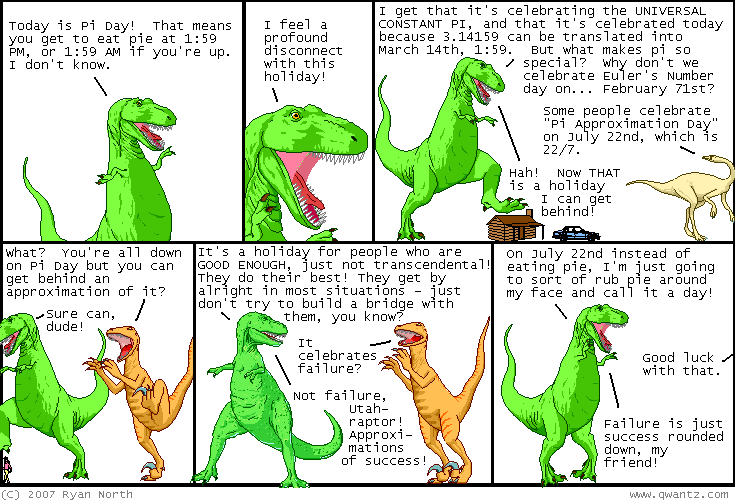
Pi day celebrated on 3/14 (sometimes at Pi time at 1:59:26 p.m) celebrates the unique irrational number pi. I remember in grade school celebrating with pies, possibly pizza, and other round foods that embody pi.


A dino comic about pi

Pi is approximated as 3.1415926535..., this website has calculated it to the millionth digit. My calculus teacher in high school had memorized a thousand digits the last time I remember. Why anyone would need to know a thousand digits of pi, I'll never know.


You can search for certain number strings in pi (my birthdate occurs after the millionth digits of pi). And even listen to the pi rap or do Pi day activities.

This article summarizes the superiority and geekiness of pi.


Different types of pi


And I found this somewhere on the internet:

The formula for volume of a cylinder:
V(cylinder) = pi * radius^2 * height

For a pizza of radius "z" and height "a".
V (pizza) = pi zz a

.

Friday, March 5, 2010

Multiplication approaches

When I started volunteering in my fifth grade class, we had an exercise that says "Solve this equation in two different ways." I panicked because I had ever only learned one way - the standard algorithm for multiplication.


Luckily, I've been working on enough multiplication tables now that I have a variety of ways to solve multiplication problems! It's great, my students have taught me a thing or two. I'll go over some different ways of multiplying that don't require a good knowledge of DDR.

1) Adding
Yes, it's not the preferred method of multiplication at the 5th grade level, but every once in a while, it may work. I would suggest you convince your students that it's not the most efficient way to do multiplication, especially if you're doing anything higher than one digit multiplication.

2) Partial sums
I've touched on this in my Greg Tang posts, but we can work through this method here. I actually really like this method and I think it works well for smaller two digit multiplication.

To do partial sums, you use several "easy" products and sum them all up to get to the answer. In the case of 83 x 24:

83 x 10 = 830
83 x 10 = 830
83 x 4 = 332

830 + 830 + 332 = 1992

Easy, no?

3) The array
I actually really enjoy this method as well. It's a more involved method of partial sums, but the visual aspect of it helps some students more than others.


You set up by making a box and separating the tens and ones. Multiply through and put your answers in the boxes. Then add everything up.


Make sure you get your students to check their zeros when multiplying the tens. Ask them how many zeros you start with and how many are in the answer. It will help with their self checking later on.

So there you have it, four methods to solving a multiplication problem!


On a side note: leave it to the fifth graders to call me out on my doofy haircut. And I got the most adorable chorus of "Hi Ms. Minh" again when I came into the 3rd grade class. They. are. so. cute. I don't think it'll wear off anytime soon. I hope it doesn't.


.

Plus or minus

Yesterday while I was signing myself out for lunch and a quick run to the bank, I noticed that many of my co-workers use the plus or minus sign to indicate an approximation of when they would be coming back to the office. I've always kind of enjoyed the symbol and even considered getting a pretentious plus or minus tattoo somewhere. Luckily for me, I decided against it.


For me, the plus or minus symbol can be used in everyday life as an approximation of time. Back in grade school, the symbol represents possible solutions to algebra equations that can be either negative or positive.

For example the solution to: y = | x | allows solutions of x to be either negative or postive, because of the absolute value function. Another example: 4 = x squared. The solutions for this very simple equation are plus or minus two, because squaring either will give you an answer of positive 4.

The simplicity of the symbol, what it represents, and the way it looks are some of the reasons why I love the plus or minus symbol and mathematical symbols in general.


I searched online to see what kinds of things I would come up with. There are is a myspace group called plus/minus, a techno music forum, and an avant-garde octet from Belgium.

The more interesting links that come up on Google are a decision making tool that I might actually use in the future, and finally the plus or minus game.


Try it out! The plus or minus game is very simple to play, but I have yet to figure out how to win the game consistently. There is a cryptic solution/hint to winning, but I need some more practice to figure out the hint and start winning. I can win with just five digits, but seven is more tough. *edit* I figured it out. I can't mathematically figure it out right now, but I'm so nerdy that I am almost tempted to spend the rest of my day trying to figure it out.


All links and pictures are from Google.

.

Tuesday, March 2, 2010

Greg Tang: Place Values


Part two of the workshop is place values and Greg making us compute in different bases. Place values boiled down are groupings of different size units. Although many students learn about place values in elementary school, we don't spend enough time teaching students to really understand place values enough so when they get to adding and most importantly subtracting, that they understand regrouping or borrowing and why they need to borrow from the next place value.

In the number 43, the 3 represents 3 ones, and the 4 represents 4 tens. Our number system is in base 10, which is also called the decimal system.

Base 10 means grouping place values by 10s. A group of 10 ones can be grouped into one group of tens. A group of 10 tens can be grouped into one group of hundreds, etc. Greg simplified it by saying, 10 is too many, so we group things into groups of ten.

We had to switch to a different base, where place values are different depending on different size groups. We did some exercises in base 5, and changing it back to base 10 where we understand the numbers better. Changing bases helped me understand place value a lot better and even helped me understand enough to be able to explain to my students.

----------------

Even in "real life" math, we do deal with different bases, and a firm understanding of place values. For example, in dealing with time, we have to switch to base 60 to figure out elapsed time. Greg's example was finding the total elapsed time for:

1 hour 45 minutes and 30 seconds
1 hour 19 minutes and 50 seconds

When we're adding up the seconds, you get 80 seconds, but of course, no one would leave 80 seconds in the final answer, you have to regroup for a group of 60 seconds, or one minute, and have the remaining 20 seconds.

With our regrouped minute, we add to 45 minutes and 19 minutes, which equals 65 minutes. Again regrouping into 60 minutes (1 hour) and remaining 5 minutes, we add to the hours place value.

Ending up with:

3 hours 5 minutes and 20 seconds

instead of:

2 hours 64 minutes and 80 seconds

Which mathematically makes sense, but no one in the real world would be comfortable leaving an answer like such. It goes to show that anyone who understand time and time conversions have an understanding of base 60, but very few people talk about changing bases.

----------------

Having a firm understanding of place values is incredibly important for doing fraction and decimal equations.

4 and 5/7ths + 3 and 5/7ths = 7 and 10/7ths, but improper fractions are usually frowned upon, so students have to understand that in this case, 7 is too much and you have to regroup to get a proper fraction. Regrouping the 10/7ths into 1 whole and 3/7ths gets us to the "proper" answer:

4 and 5/7ths + 3 and 5/7ths = 8 and 3/7ths

-----------------

Where this comes most handy in most Math Rules! math is subtraction and fractions & decimals. Helping students with regrouping in subtraction can be easier for this problem:

800
-347

Instead of regrouping twice for both zeros, thinking of 80 tens, and 0 ones and regrouping once to get 79 tens and 10 ones. Which is much easier and doesn't involve regrouping twice.

79 tens | 10 ones
- 34 tens | 7 ones

It also works for bigger numbers, to see that
1000
-458

Can also be seen as:

100 tens | 0 ones
-45 tens | 8 ones

And regrouped once to get:

90 tens | 10 ones
-45 tens | 8 ones

Making this problem a lot easier to solve with less work.

------------------------------

I'm looking forward to the third workshop with Greg because like I said yesterday, it's a revolutionary way (for me) of looking at math problems that will help me help my students. Not only do I feel better at math, I have a firm grasp of number sense and Greg's two main concepts of partial sums and place values which will be useful for working with 3rd - 5th graders.

.

Monday, March 1, 2010

Greg Tang math workshop

I got an incredible opportunity to attend a math support session/workshop with children's math book author Greg Tang today. This post is pretty numbers heavy, but if you skip to the end (where the other picture is), I've put in my two cents on the first half of what we covered today.


We started with a refresher course from Greg's 1st session back in December which covered breaking numbers down into partial sums to make addition, subtraction, multiplication, and division easier.

12 - 5 is an example of breaking a number down into partial sums.
12 - 5 can also be seen as
12 - (2 + 3) or
12 - 2 = 10
then 10 - 3 = 7.

Instead of using 5 as a concrete aboslute number, it can be seen differently in different situations. Greg also put up these equations to show this concept:
13 - 6
12 - 6
11 - 6
Sure, the 6 is the same in all cases, but if you conceptually think of 6 as different sums, it makes addition or subtraction much easier.

13 - 3 (10) - 3 = 7
12 - 2 (10) - 4 = 6
11 - 1 (10) - 5 = 5

Greg also said that building on a student's number sense will allow them to apply similar ideas on harder equations. If a student can use partial sums to do 12 - 5, they can apply it to 82 - 5 using the same ideas. Unfortunately, math education is cumulative building off the basics of addition which carries to subtraction. Addition also carries to multiplication. Multiplication then to division.

Another take away point of Greg Tang's workshop are the "easy" numbers to learn. The math world according to Greg says that multiplication should be taught in a different order. Memorization is detrimental because then children don't grasp number sense and what numbers actually represent. If children memorize the multiplication table, they'll only ever be able to do problems that involve 0x0 through 12x12. Developing methods to figure out answers is what Greg taught us. It also will lead to higher level math when factoring comes into the equation (pardon the pun). Students who have memorized the multiplication table don't have an understanding of factors. Factoring 56 becomes a much harder problem when you memorize instead of build from the basics up.

Greg told us children should learn their multiplication facts for the 0s first, then 1s, 10s, and 2s. The zero and one families are self explanatory. The 10s should be taught in terms of place value instead of "the trick to add a zero to the end." 5 x 10 should be thought as five tens. 345 x 10 should be thought as 345 tens. 2s are double what you started with.

Then to 3s, which is a double + one more:
24 x 3 =
double 24 = 48
48 + one more = 72.

4s are two sets of doubles:
15 x 4 =
double 15 = 30
doubled again 60.

5s and 9s depend on a solid understanding of 10s. 5s are really just half of 10s. Easy numbers to halve:
5 x 86 =
10 x 86 = 860
half of 860 = 430

And not so easy numbers to halve:
5 x 39 =
10 x 39 = 390
half of 390 isn't as "off the top of your head", but it can be easier if you see it as 300 + 90
half of 300 = 150
half of 90 = 45
150 + 45 = 195 = 5 x 39

9s are 10 subtracting one:
16 x 9 =
16 x 10 = 160 minus one
160 - 16 =
160 - 10 = 150
150 - 6 = 144
16 x 9 = 144

6s are double groups of 3s.
8s are double groups of 4s.
7s are no fun and make life hard.
But you can still use the idea and use a group of 5 and a group of 2s to get to your answer.

Finally division. Greg noted that division also uses these concepts of breaking down numbers into easier groupings to make math easier:
192 / 16 =
can be seen as 160 (which is an easy group to spot and understand) + 32 (which should also be apparent if you've got a firm understanding of your multiplication groups)
160 / 16 = 10
32 / 16 = 2
10 + 2 = 12
192 / 16 = 12

A not so easy division problem:
128 / 16 =
The process for this one is reducing the division problem. Greg said that teachers encourage students to reduce fractions, but not division problems.
Dividing both by 2 gives you 64 / 8, which is much easier to deal with.


And all of this in about 45 minutes! I apologize for the number heavy post today, but it was so incredible to see math in this way. It's so easy to grasp now as an adult, but I think it's also much easier for children to get a solid understanding of number sense this way.

It's unfortunate when you come in and a student is counting to do his/her multiplication problems. In most situations you don't have time to go back to addition (which is where multiplication really starts) to show them breaking down numbers. I still think there are opportunities for tutors and educators to work these ideas into learning situations. Sure, you can't reteach a student a completely different approach to math, but if your student asks: what's 6 x 8? You can come back with, what's 3 x 8? Can you double that? Isn't six 3 x 2? And if you do it often enough, students will stop depending on multiplication tables and charts that teachers put up in their classrooms and work out these more difficult multiplication problems themselves.

I'll post again tomorrow about the second half of the workshop (yeah, we covered a lot in a very short amount of time) on place values and thinking about grouping in a different way.


.

Friday, February 26, 2010

Barf, tears, and crushes

I will apologize in advance for this post and the title, but if you read on, it sums up my tutoring today very nicely.

I had the opportunity to help in another classroom today, a 3rd grade Sheltered English Instruction (SEI) class with roughly 20 squirmy third graders doing multiplication word problems. I got a warm welcome chorus of "Hi Ms. Minh!" from 20 eager and excitable children and a speed round of names to memorize in thirty minutes.


The teacher Ms. Ph had the students on the carpet and was asking word problems like "There are 8 dogs, each dog has 6 puppies. How many puppies are there?" and the students would have to repeat the equation and the answer.

No more than five minutes after I got the classroom, a student with some stomach virus threw up on the carpet and made a trail to the trashcan. I'm not even going to sugarcoat this one, it was naaaasty. Nasty.

I was surprised at how well the kids handled the situation though, most of them kept their focus and we continued on with the math. The students finished up with group work, and went back to their desks to do all class multiplication fact families. Ms. Ph would ask and write on the board:

11 x 12 =

To which the students were to compile the fact family:

11 x 12 = 132
12 x 11 = 132
132 / 12 = 11
132 / 11 = 12

I walked around and helped the students. I was about to say "This isn't how Math Rules! works" but I felt I would be more helpful by circulating the entire class and helping to check fact families, I let it go. The students were enthusiastic about math which was nice to see and experience. By circulating I got a good sense of which students needed help, which students wanted attention, and which students wanted someone to check over their answers.

At one point, another student came to inform my class they would have computer class instead of science (or something like that). This student unfortunately disrespected one of the students in my class, which upset her and she started crying. Which is not very nice at all. Ms. Ph handled the situation well, but the upset student wasn't ok. I stepped in and used a mentoring moment to tell the student that it was just probably because the offending student doesn't like herself very much that she has to put others down. I hope it made her feel better, but you can never really tell. I think I'll follow up next week with her. It's a shame because she seems like a very bright student and enjoyed doing math.

Math homework was given out, the students had to copy equations on a sheet of paper and bring back fact families. Two students who were sitting next to each other were bickering, and I asked them what was up as I was circulating. Each time I came by there were new developments. They were teasing each other:
"She punched me"
"He kicked my shin"
"She threw this piece of paper at my face, look what it did!"

I did not point out the fact that this probably means they liked each other, but it was incredibly adorable and amusing to say the least.

I'm extremely excited to be working in the class now, there's a lot of good math potential, positive energy, and interesting characters in this class. I'm looking forward to it.

Have a great weekend everyone!


.

Wednesday, February 24, 2010

We like fractions!


Yesterday's tutoring involved an introduction to fractions in my 4th grade class. I think it's cool to see the intrinsic nature of understanding fractions. For students, doing math computations with fractions quickly becomes difficult. Even as adults, we shy away from fractions, decimals, percentages, and ratios, which all express the same ideas. It's hard to conceptually think of a quarter of a third or to add up 1/6 a teaspoon to 3/4 of a teaspoon and even more so to compute complex fraction equations. Personally, I can't verbally explain what happens when you divide a fraction by another. Completely out of my realm.

However, being able to divide something into fractions and the visual understanding of equal parts is something kids pick up quickly. Our class was dividing up 4x6 arrays into fractions, like a quarter, an eighth, thirds, and sixths. The arrays have 24 smaller units inside, but my students did very well with dividing up squares and rectangles into thirds then sixths. I pushed them further and asked what 1/3 or 1/6 of the whole represents in units, which they quickly got as well.

One of my students came up after we had finished and declared, "I like fractions!" which I thought was nice. I just hope she continues to like fractions when you start adding different denominator fractions...

Mr. Steven Strogatz's newest article is also about the existence of fractions and the ensuing chaos of irrational numbers.

More cartoons of fractions.

.

Thursday, February 18, 2010

Group work pt II

So how does a Math Rules! volunteer manage a small group effectively? I found an article online that is pretty dense in content, and doesn't even address group work in schools. I still thought that many of the main ideas apply to working with a small group of elementary school students. The Personal Functions section is especially nice to note. The Managing conflict, Stopping conflict escalation, and Disruptive Behaviors sections are important for volunteers who have been having a grand ol' time trying to manage their small groups.


This article called Promoting Problem-Solving Skills in Elementary Mathematics is also quite useful for managing and provides best approaches to math group work. I have seen the teachers I work with use the Problem of the Day and Whole Group Learning techniques as the group lesson for the students and also for me to guide the group work afterwards. My teacher would write a problem on a flip chart, ask the students to copy down the problem in their notebooks and then to solve it. Afterwards, she asks for volunteers to explain what they got and how they got there. Directly from the article, the big group lesson for the day allows students to:

o identify the parts in the question
o find the best problem-solving strategy and explain why it is the best
o describe two different ways a problem could have been solved
o share student-generated questions
o ask other students to solve the problem and justify their answers

These skills and approaches to teaching are also useful in small groups. The article outlines that students benefit from being in mixed-ability groups (to encourage less motivated/focused/confident students to work with and learn from the more motivated/focused/confident students) as well as similar ability groups. Hopefully, Math Rules! groups are more similar ability small groups. I've also mentioned before on this blog that even in "similar ability" groups there is a lot of variation in specific abilities.


.